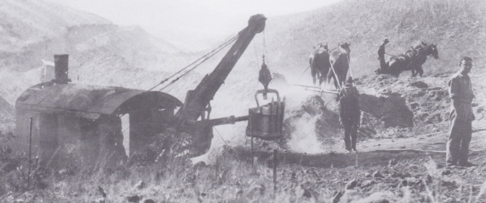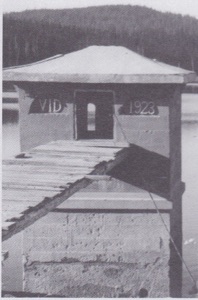
The availability of more water for irrigation and domestic use enabled the ranch to offer more of its subdivided lands for sale. The sale of these 20 acre parcels provided fresh income for the company. Despite all of the new investment, the ranch was still losing money! Even a bumper crop of fruit in 1912 didn’t make an appreciable difference. As Lady Aberdeen wrote in her journal; “the results of our investments in BC have been very sad.”
Tough Times - Receivership
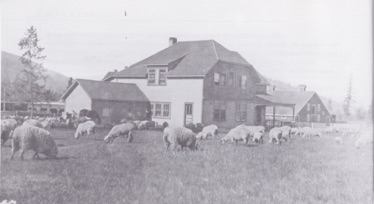
The Coldstream Estate Company went into receivership in 1914. W. A. Pitcairn of Kelowna was appointed manager and with him came his assistant, F. E. R. “Fluffy” Wollaston. They managed the ranch for the next four tumultuous years. They sold off all the cattle along with sheep and goats but still the Ranch’s expenses exceeded its income. Wollaston wrote, “a cattle ranch without any cattle is a rather hopeless proposition.”
The first world war brought its own set of problems with most of the immigrants rushing off to enlist. During the war, orchards were not properly irrigated, pruned, or thinned and the irrigation system fell into disrepair. Sir James Buchanan took out a mortgage on the ranch in 1916 but that did not solve the company’s problems. In 1919 the company was put up for sale with a Japanese syndicate wanting to purchase the land for immigrants. The local people were vocally opposed so Buchanan let it be known that the ranch would remain in the hands of Canadians so offered the ranch for sale to the provincial and federal governments. Both governments refused!
Exit the Aberdeens
Eventually James Buchanan bought out Cowdray’s and Lord Aberdeen’s remaining shares to become the sole owner of Coldstream Estates. To stay afloat Buchanan sold off land at the junction of Aberdeen and White Valley Roads to 16 Ukrainian families. Then in 1924, he signed the Coldstream Ranch over to his only daughter, Catherine McDonald-Buchanan.
The Depression
Due to the Depression and despite bumper crops and the harvesting of lumber, the ranch operated at a loss for most of the 30s. In 1934, 4,700,000 boxes of apples were picked, the largest ever produced. But there was no market for this bumper crop which was either dumped in the orchards or into the lake.
Marketing remained a problem until 1937, when the province passed the Marketing Act which gave producer boards the power to regulate inter-provincial trade. With one-desk, centralized sales, marketing of the Coldstream Ranch apples was at last organized. However, labour shortages remained a problem, especially during the bumper crop years. During World War II, even with soldiers being seconded to the fields to pick, there was still a major labour shortage.
World War II
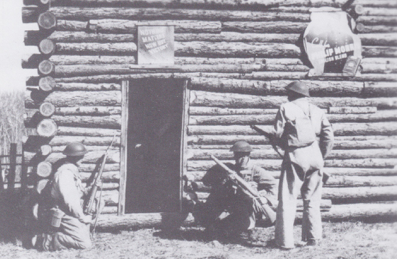
The Ranch was used as a training facility for Canadian troops with 8500 acres set aside for military manouvers and a log village was built for street fighting simulations. Permanent kitchens and a Social Hall were built, but the men stayed in tents. The Social Hall still stands today and is used periodically for Coldstream Ranch events.